Souk El Arbaa eclipse 2027: 1 min 40 s of totality
Souk El Arbaa, Rabat-Salé-Kénitra, Morocco · Monday, August 2, 2027 · all times local (UTC+0)
Yes. Souk El Arbaa is inside the path of totality. The Moon covers the whole Sun for 1 min 40 s, from 08:45:41 to 08:47:21 local time (UTC+0) on Monday, August 2, 2027. At mid-eclipse the Sun is 38° above the horizon toward the E.
Eclipse times in Souk El Arbaa
- 07:39:54 · Partial eclipse begins (first contact)
07:39:54 UTC · Sun 24° up, E (84°) - 08:45:41 · Totality begins (second contact)
08:45:41 UTC · Sun 38° up, E (94°) - 08:46:31 · Maximum eclipse
08:46:31 UTC · Sun 38° up, E (94°) - 08:47:21 · Totality ends (third contact)
08:47:21 UTC · Sun 38° up, E (94°) - 10:00:05 · Partial eclipse ends (last contact)
10:00:05 UTC · Sun 53° up, ESE (107°)
Times are for the town's coordinates (34.685°, -6.003°, 38 m), computed with NASA GSFC's eclipse code from NASA's Besselian elements (ΔT 71.7 s). They assume a smooth lunar edge; mountains on the Moon shift totality by a few seconds, and other sources using a different ΔT can differ by up to about 10 s.
Where Souk El Arbaa sits in the path
Souk El Arbaa is about 111 km from the central line and 7 km inside the southern limit of the path. Totality is longest on the central line and drops off quickly near the edges, where a few kilometres can change it by tens of seconds.
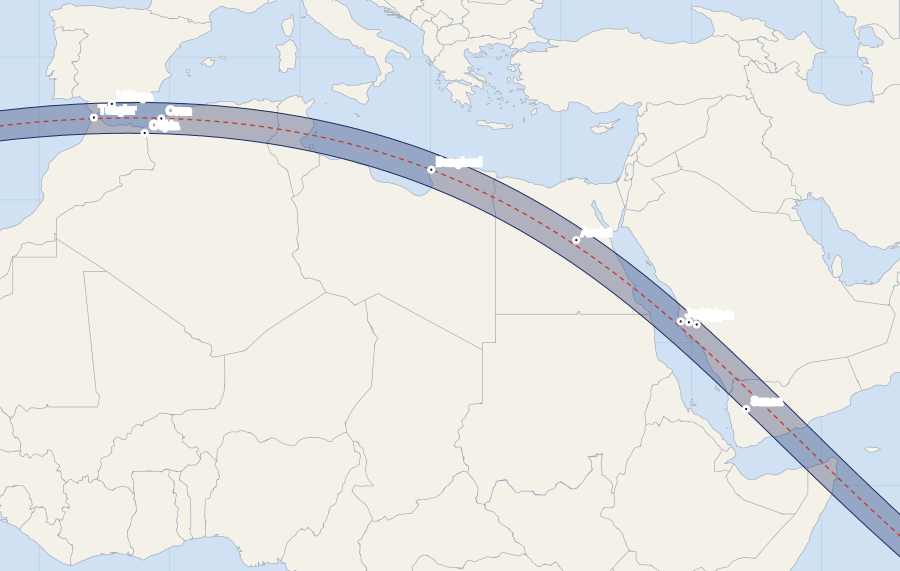
Shaded band: path of totality (NASA limits). Dashed line: central line. Red dot: Souk El Arbaa.
Longer totality nearby
| Place | Distance | Totality | Begins |
|---|---|---|---|
| Tétouan | 115 km | 4 min 51 s | 08:45:08 |
| Tangier | 122 km | 4 min 50 s | 08:44:42 |
| Fnidek | 142 km | 4 min 50 s | 08:45:15 |
| Asilah | 87 km | 4 min 45 s | 08:44:22 |
| Algeciras | 169 km | 4 min 27 s | 10:45:25 |
Photographing it with a smart telescope
The Sun is about 0.53° across. A smart telescope's field must be wider than that to frame the whole disk, and roughly 1.5° or more on the short side to show the inner corona during totality. Keep a certified solar filter on for every partial phase, and take it off only during the 1 min 40 s of totality.
| Telescope | Field (short side) | Frames the Sun? |
|---|---|---|
| Seestar S30 Pro | 2.24° | Yes, with room for the inner corona |
| DWARF 3 | 1.65° | Yes, with room for the inner corona |
| Vespera Pro 2 | 1.60° | Yes, with room for the inner corona |
| Vespera 3 | 1.40° | Yes, whole disk |
| Vespera II | 1.40° | Yes, whole disk |
| Seestar S50 Pro | 1.38° | Yes, whole disk |
| DWARFLAB Draco | 1.24° | Yes, whole disk |
| DWARF mini | 1.20° | Yes, whole disk |
| Celestron Origin Mark II | 0.75° | Yes, whole disk |
| Unistellar eQuinox 2 | 0.57° | Only just (cropped edges likely) |
| Unistellar eVscope 2 | 0.57° | Only just (cropped edges likely) |
| Unistellar Odyssey | 0.56° | Only just (cropped edges likely) |
| Unistellar Odyssey Pro | 0.56° | Only just (cropped edges likely) |
Fields computed from each maker's published sensor and focal length; see the field-of-view tool. At 38° the Sun is high enough that most mounts can track it.
Eye safety
Look at the Sun only through eclipse glasses or a viewer that meets ISO 12312-2, and check the supplier against the American Astronomical Society's list. Only during totality itself is it safe to look without protection; put glasses back on as soon as the Sun's edge reappears. See our eclipse glasses guide.
Questions
What time is the eclipse in Souk El Arbaa?
The partial phase begins at 07:39:54, totality runs 08:45:41–08:47:21, and the eclipse ends at 10:00:05 local time (UTC+0) on August 2, 2027.
Is the 2027 eclipse total in Souk El Arbaa?
Yes. Souk El Arbaa is inside the path, with 1 min 40 s of totality at the town coordinates.
How long does the whole eclipse last in Souk El Arbaa?
About 2 h 20 min from first to last contact, if the sky is clear.
Is it usually cloudy in Souk El Arbaa in August?
NASA POWER's 2001–2025 satellite climatology gives an average cloud amount of 24% for August at this location. That is a long-term average, not a forecast.
Source: NASA GSFC Besselian elements (Espenak & Meeus) and NASA's path table; coordinates GeoNames (CC BY 4.0); cloud NASA POWER CLOUD_AMT climatology.