Girga eclipse 2027: 6 min 23 s of totality
Girga, Sohag, Egypt · Monday, August 2, 2027 · all times local (EEST (UTC+3))
Yes. Girga is inside the path of totality. The Moon covers the whole Sun for 6 min 23 s, from 12:59:29 to 13:05:52 local time (EEST (UTC+3)) on Monday, August 2, 2027. At mid-eclipse the Sun is 81° above the horizon toward the S.
Eclipse times in Girga
- 11:37:53 · Partial eclipse begins (first contact)
08:37:53 UTC · Sun 69° up, ESE (110°) - 12:59:29 · Totality begins (second contact)
09:59:29 UTC · Sun 81° up, S (181°) - 13:02:41 · Maximum eclipse
10:02:41 UTC · Sun 81° up, S (186°) - 13:05:52 · Totality ends (third contact)
10:05:52 UTC · Sun 81° up, SSW (191°) - 14:24:08 · Partial eclipse ends (last contact)
11:24:08 UTC · Sun 68° up, WSW (251°)
Times are for the town's coordinates (26.337°, 31.893°, 78 m), computed with NASA GSFC's eclipse code from NASA's Besselian elements (ΔT 71.7 s). They assume a smooth lunar edge; mountains on the Moon shift totality by a few seconds, and other sources using a different ΔT can differ by up to about 10 s.
Where Girga sits in the path
Girga is about 3 km from the central line and 128 km inside the southern limit of the path. Totality is longest on the central line and drops off quickly near the edges, where a few kilometres can change it by tens of seconds.
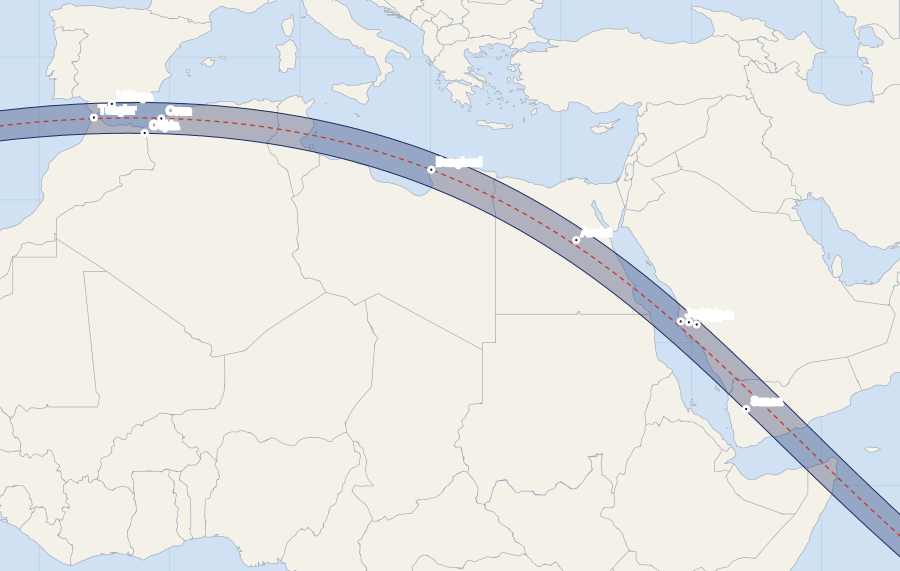
Shaded band: path of totality (NASA limits). Dashed line: central line. Red dot: Girga.
Photographing it with a smart telescope
The Sun is about 0.53° across. A smart telescope's field must be wider than that to frame the whole disk, and roughly 1.5° or more on the short side to show the inner corona during totality. Keep a certified solar filter on for every partial phase, and take it off only during the 6 min 23 s of totality.
| Telescope | Field (short side) | Frames the Sun? |
|---|---|---|
| Seestar S30 Pro | 2.24° | Yes, with room for the inner corona |
| DWARF 3 | 1.65° | Yes, with room for the inner corona |
| Vespera Pro 2 | 1.60° | Yes, with room for the inner corona |
| Vespera 3 | 1.40° | Yes, whole disk |
| Vespera II | 1.40° | Yes, whole disk |
| Seestar S50 Pro | 1.38° | Yes, whole disk |
| DWARFLAB Draco | 1.24° | Yes, whole disk |
| DWARF mini | 1.20° | Yes, whole disk |
| Celestron Origin Mark II | 0.75° | Yes, whole disk |
| Unistellar eQuinox 2 | 0.57° | Only just (cropped edges likely) |
| Unistellar eVscope 2 | 0.57° | Only just (cropped edges likely) |
| Unistellar Odyssey | 0.56° | Only just (cropped edges likely) |
| Unistellar Odyssey Pro | 0.56° | Only just (cropped edges likely) |
Fields computed from each maker's published sensor and focal length; see the field-of-view tool. At 81° the Sun is high enough that most mounts can track it.
Eye safety
Look at the Sun only through eclipse glasses or a viewer that meets ISO 12312-2, and check the supplier against the American Astronomical Society's list. Only during totality itself is it safe to look without protection; put glasses back on as soon as the Sun's edge reappears. See our eclipse glasses guide.
Questions
What time is the eclipse in Girga?
The partial phase begins at 11:37:53, totality runs 12:59:29–13:05:52, and the eclipse ends at 14:24:08 local time (EEST (UTC+3)) on August 2, 2027.
Is the 2027 eclipse total in Girga?
Yes. Girga is inside the path, with 6 min 23 s of totality at the town coordinates.
How long does the whole eclipse last in Girga?
About 2 h 46 min from first to last contact, if the sky is clear.
Is it usually cloudy in Girga in August?
NASA POWER's 2001–2025 satellite climatology gives an average cloud amount of 9% for August at this location. That is a long-term average, not a forecast.
Source: NASA GSFC Besselian elements (Espenak & Meeus) and NASA's path table; coordinates GeoNames (CC BY 4.0); cloud NASA POWER CLOUD_AMT climatology.